



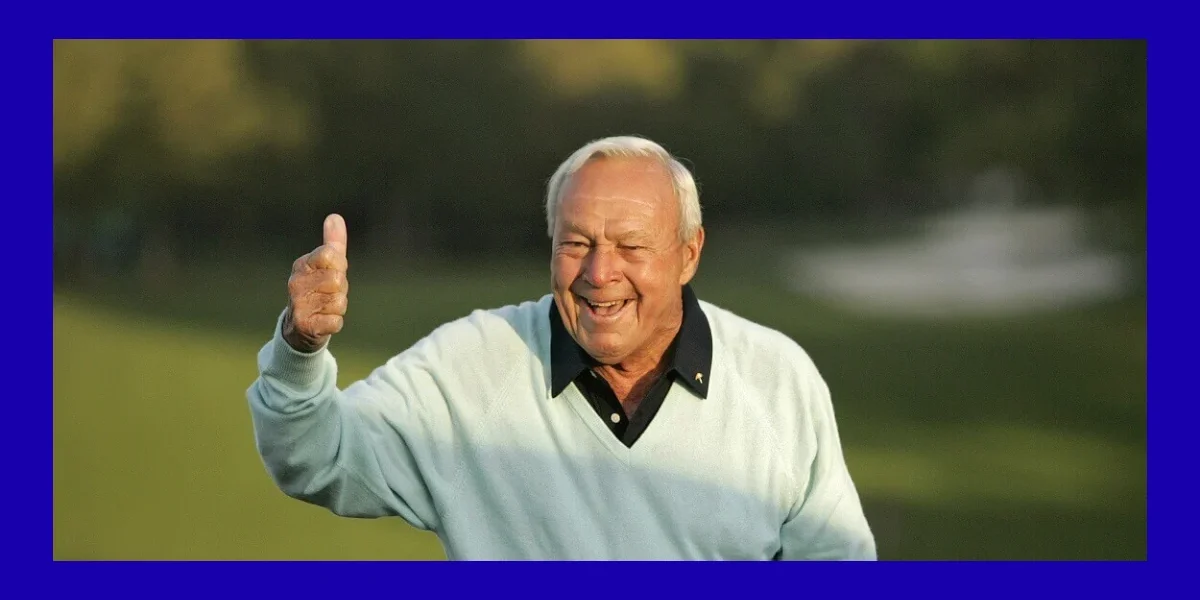

Arnold Palmer was an American professional golfer born on September 10, 1929, in Latrobe, Pennsylvania. Known as “The King,” he won seven major championships and 62 PGA Tour titles. His charismatic personality helped transform golf into a mainstream sport. He passed away on September 25, 2016, at the age of 87.
Table Of Content
- Introduction
- Early Life and Family Background
- Education and Academic Journey
- Physical Appearance and Personality
- Parents
- Father — Milfred “Deacon” Palmer
- Mother — Doris Morrison Palmer
- Siblings and Extended Family
- Career and Professional Life
- Personal Life and Privacy
- Media Presence and Public Perception
- Net Worth and Lifestyle
- Future Prospects and Legacy
- Legacy and Influence of Family
- Conclusion
- Frequently Asked Questions
| Attribute | Details |
|---|---|
| Full Name | Arnold Daniel Palmer |
| Date of Birth | September 10, 1929 |
| Age at Death | 87 years old |
| Date of Death | September 25, 2016 |
| Place of Birth | Latrobe, Pennsylvania, USA |
| Nationality | American |
| Profession | Professional Golfer, Businessman, Golf Course Designer |
| Famous For | Seven Major championships, 62 PGA Tour wins, popularizing golf for the common man |
| Father | Milfred “Deacon” Palmer |
| Mother | Doris Morrison Palmer |
| Siblings | Jerry Palmer (brother), Lois Jean Tilley (sister), Sandra Sarni (sister) |
| Marital Status | Married twice — Winifred “Winnie” Walzer (1954–1999, her death); Kathleen “Kit” Gawthrop (2005–2016, his death) |
| Known Traits | Charismatic, bold, warm, down-to-earth, daring |
| Social Media Presence | Arnold Palmer’s legacy is carried forward at @arnoldpalmer on social platforms |
Introduction
Some people play a sport. Others change it forever. Arnold Palmer did the second thing. He did not just win golf tournaments. He picked up a club and swung it with so much heart, so much daring, and so much genuine love for the game that millions of ordinary people decided golf was worth watching, worth playing, and worth caring about.
He was not born wealthy. He did not grow up on a private estate or learn the game at an exclusive club. He grew up in the shadow of a golf course in a small Pennsylvania town, the son of a groundskeeper who handed him his first club when he was three years old. From that simple beginning, Arnold Palmer built one of the most remarkable lives in sports history.
This is his story.
Early Life and Family Background
Arnold Daniel Palmer came into the world on September 10, 1929, in Youngstown, Pennsylvania. Shortly after his birth, his family moved to Latrobe, a small industrial city nestled near the foothills of the Allegheny Mountains in western Pennsylvania, about fifty miles east of Pittsburgh. It was a working-class town, and the Palmers were a working-class family in every meaningful sense of the word.
He was the eldest of four children born to Milfred “Deacon” Palmer and his wife, Doris. The family lived at the edge of the Latrobe Country Club, where his father worked first as a greenskeeper and later as the head golf professional. Growing up so close to the course meant that young Arnold was around the game of golf from the very beginning of his life. It was not just a hobby in the Palmer household. It was a way of life.
From the time he was old enough to walk alongside his father, Arnold was on that course. He helped maintain it, caddied on it, and eventually played on it whenever he could sneak away. The experience gave him not just technical skill, but a deep, genuine love for everything the game represented.
His childhood was modest but happy. The family did not have luxury, but they had closeness. They had work ethic. And they had a father who believed in his son’s talent long before the rest of the world would catch on.
Education and Academic Journey
Arnold attended Latrobe High School, where he quickly established himself as one of the finest young golfers anyone in the region had ever seen. Over four years on the school golf team, he lost just one match. That record was not a coincidence. It was the product of daily practice, natural talent, and the quiet, steady instruction of his father.
During his senior year, he struck up a friendship with Bud Worsham, whose brother Lew was a professional golfer. Worsham encouraged Arnold to pursue his talent at the college level, and Palmer accepted a golf scholarship to Wake Forest College in North Carolina. He arrived there in 1947 and immediately began dominating college tournaments the same way he had dominated high school competition.
His college years were cut short by personal tragedy. During his senior year, Bud Worsham was killed in a car accident. Shaken and heartbroken by the loss of his close friend, Palmer left school and enlisted in the United States Coast Guard, where he served for three years. Even during his military service, he continued to play and develop his game, building a nine-hole course during his time in the service.
After his discharge, he returned to Wake Forest and continued his golf scholarship, though he never completed his degree. The college later awarded him an honorary doctorate in the humanities, a fitting acknowledgment of a man who had gone on to educate the world about the beauty of the game he loved.
Physical Appearance and Personality
Arnold Palmer was a striking physical presence on the golf course. He stood around five feet ten inches tall and was known for a broad, powerful build that gave him one of the most feared drives in the sport. His hands were large and strong, and his swing was uniquely aggressive, a style that set him apart from the more measured approach of many of his peers.
But it was not his body that made people fall in love with Arnold Palmer. It was his personality. He had a gift for warmth that was impossible to fake. He remembered names. He made eye contact. He signed every autograph he could. When he played, his face told the whole story. Joy, frustration, determination — everything was visible. Fans felt they knew him because, in a real sense, they did.
He was plain-spoken and unpretentious in a sport that had long been associated with formality and exclusivity. He treated his caddies with the same respect he showed corporate sponsors. He talked to working-class fans the same way he talked to presidents. That genuine, democratic warmth was as much a part of his legacy as any trophy he ever won.
Parents
Father — Milfred “Deacon” Palmer
No single person shaped Arnold Palmer’s life more completely than his father. Milfred Jerome Palmer, known to everyone as “Deacon,” was a man of quiet strength and deep character. He had suffered from polio at a young age, which left him with physical limitations that never dimmed his spirit or his work ethic. He served as both the head professional and greenskeeper at the Latrobe Country Club for decades, a dual role that required both skill and dedication.
Deacon was a strict but loving father. He gave Arnold his first set of golf clubs at the age of three and began teaching him the fundamentals of the game as soon as the boy could hold a club. His philosophy was straightforward: hit through the ball, not at it. Keep your head down. Work hard every single day. These were not just golf lessons. They were life lessons.
The relationship between Deacon and Arnold was tender and deep. Arnold spoke about his father with open admiration throughout his life. When he achieved success, he credited his father. When he faced setbacks, he drew on his father’s example of perseverance. In 1971, Arnold purchased the Latrobe Country Club — the very club where his father had worked his entire career — and owned it until his own death. It was an act of love and loyalty that said everything about who Arnold Palmer was as a son.
Mother — Doris Morrison Palmer
Doris Palmer was the warm heart of the family home. She raised four children in a household that prioritized hard work, humility, and family closeness. While Deacon shaped Arnold’s relationship with golf, Doris shaped his character. She was known within the family as a strong, compassionate woman whose faith and kindness influenced all of her children.
Doris faced significant health challenges in her later years, suffering from crippling arthritis. She passed away in 1979 after a long and brave battle with the illness. Arnold, by that time one of the most famous athletes in the world, mourned her deeply. His love for both parents was a constant thread woven through his public life and his private conversations.
Siblings and Extended Family
Arnold grew up with three siblings — his brother Jerry and his sisters Lois Jean, who went by “Cheech,” and Sandra, known as Sandy. The four children shared a classic working-class upbringing in western Pennsylvania, one defined by family meals, outdoor life, and the rhythms of a small community.
Jerry Palmer followed his father’s path at Latrobe Country Club, succeeding Deacon as the course superintendent and later serving as general manager for many years. He remained part of Arnold’s personal office staff throughout much of his career, a sign of how tightly bound the Palmer family remained even as Arnold’s fame grew to global scale.
His sisters Lois Jean and Sandra settled in their home region of western Pennsylvania, staying close to the roots that had shaped all of them. The Palmer siblings maintained genuine closeness throughout their lives, a fact that Arnold spoke about with quiet pride on many occasions.
Career and Professional Life
Arnold Palmer turned professional in November 1954, just weeks after winning the United States Amateur Championship in Detroit. That amateur title had given him confidence and clarity. He knew he was ready. And he was right.
His debut year saw him win the Canadian Open. By 1958, he claimed his first Masters title at Augusta National, one of the most prestigious tournaments in golf. What followed was one of the most dominant stretches in the history of any sport. From 1960 to 1963 alone, he won 29 national or international titles.
His seven major championships included four Masters victories in 1958, 1960, 1962, and 1964, one U.S. Open in 1960, and two Open Championships in 1961 and 1962. He accumulated 62 wins on the PGA Tour and ten more on the senior circuit. He was inducted into the World Golf Hall of Fame in 1974.
What made his career extraordinary was not just the winning. It was the way he won. Palmer played with open, visible emotion. He took risks other players avoided. He played aggressively when caution seemed wiser. Fans called themselves “Arnie’s Army,” and they followed him from course to course, roaring when he made the shots that nobody else would attempt and groaning when his boldness cost him. They loved him not despite his fallibility, but because of it.
Beyond the playing field, Palmer was a business pioneer. He was among the first athletes to truly understand the commercial power of a personal brand. His company, Arnold Palmer Enterprises, managed endorsements, licensing deals, and commercial partnerships across dozens of industries. He co-founded the Golf Channel in 1995. His Arnold Palmer Design Company went on to design more than 300 golf courses around the world. He owned the Bay Hill Club and Lodge in Orlando and the Latrobe Country Club in his hometown.
At the age of 85, years after he had stopped playing professionally, he was still earning an estimated forty million dollars a year from endorsements alone. His total career earnings, adjusted for inflation, are estimated at approximately 1.7 billion dollars, making him one of the three highest-earning athletes in the history of professional sports, behind only Michael Jordan and Tiger Woods.
Personal Life and Privacy
Arnold Palmer married Winifred “Winnie” Walzer in December 1954, just one month after turning professional. He had met her at a golf tournament in Pennsylvania. The two were well matched — Winnie was steady and practical where Arnold was bold and emotional, and their partnership became one of the most admired in the sport’s social history. They had two daughters together, Peggy Palmer Wears and Amy Palmer Saunders.
Their marriage lasted 45 years, ending only with Winnie’s death in November 1999. She had been diagnosed with ovarian cancer, and her passing left Arnold openly heartbroken. He had, just two years earlier, undergone his own cancer surgery and recovered. Losing Winnie was, by his own account, the deepest personal loss of his life.
Six years later, in 2005, Arnold married Kathleen “Kit” Gawthrop, who brought her own three adult children into the extended Palmer family. By all accounts, the second marriage brought Arnold genuine happiness and companionship in his final years.
His daughter Amy and her husband Roy oversaw the operations of the Bay Hill Club and Latrobe Country Club after Arnold’s health began to decline. His grandson Sam Saunders, Amy’s son, became a professional golfer in his own right. Arnold’s family legacy in golf spans at least three generations.
Arnold Daniel Palmer died on September 25, 2016, from complications related to heart problems. He was 87 years old.
Media Presence and Public Perception
Arnold Palmer was a natural in front of cameras at a time when television was just beginning to bring sports into American living rooms. His timing in history was perfect, and he understood it. He embraced the medium while staying true to himself, never performing for the camera but always being exactly who he was when the cameras happened to be pointed at him.
He appeared in countless television commercials and advertising campaigns over the decades, for brands ranging from Lincoln-Mercury to Pennzoil to Hertz. His image — honest, warm, American, down-to-earth — made him one of the most trusted faces in advertising history.
His name became permanently attached to a beverage he famously enjoyed: equal parts iced tea and lemonade. The drink, now sold commercially and known simply as “the Arnold Palmer,” is a lasting part of popular culture. He launched a line of these beverages in 2001, and they remain popular long after his passing.
Public perception of Palmer was overwhelmingly positive throughout his life and has remained so since his death. He is remembered not as a complicated figure but as a genuinely good man who happened to be extraordinarily gifted.
Net Worth and Lifestyle
At the time of his death in 2016, Arnold Palmer’s net worth was estimated at approximately 700 million dollars, with some estimates placing it closer to 875 million. The vast majority of that wealth came not from prize money — his total golf earnings were just under seven million dollars — but from his extraordinary commercial success off the course.
His lifestyle reflected both his achievements and his roots. He lived between his properties in Latrobe, Pennsylvania, and Bay Hill, Florida, never entirely leaving behind the small-town world that had shaped him. He was known as an avid private pilot who logged thousands of hours in the air, another arena where his boldness found expression.
He gave back generously throughout his life. He played a central role in raising funds to build the Arnold Palmer Hospital for Children in Orlando, one of the leading children’s hospitals in the United States. The Winnie Palmer Hospital for Women and Babies, named for his first wife, was another product of his philanthropy. His Arnie’s Army Charitable Foundation supported youth programs and community initiatives for decades.
Future Prospects and Legacy
Arnold Palmer passed away in 2016, but his future prospects — that is, the ongoing prospects of his name, his brand, and his influence — remain remarkably strong. The Arnold Palmer Invitational at Bay Hill continues to be one of the most celebrated events on the PGA Tour calendar. The Arnold Palmer Hospital for Children continues to serve families across Florida and beyond.
His grandson Sam Saunders continued to compete professionally, carrying the family name onto fairways around the world. The Palmer family’s stewardship of Bay Hill and Latrobe ensures that his vision for those properties continues to be honored.
The Arnold Palmer brand of beverages, apparel, and licensed products remains commercially active and culturally relevant. Younger generations who never watched him play still know his name, still drink his drink, still wear his logo. That kind of enduring cultural presence is rare for any athlete. For a golfer who played his best golf in the early 1960s, it is nothing short of remarkable.
Legacy and Influence of Family
The Palmer family legacy is one of the most genuine and meaningful in American sports history. It began with Deacon Palmer, a man who worked the land of a country club in western Pennsylvania and who handed his young son a set of golf clubs with no idea — or perhaps with every idea — of what would follow.
Deacon’s influence on Arnold was total. The work ethic, the love of the game, the quiet dignity, the connection to ordinary people — all of it traced directly back to that greenskeeper who taught his son not just how to swing a club but how to live a life worth living.
Arnold carried those lessons outward and upward, into the public eye, into business, into philanthropy, into a cultural presence that outlasted his playing career by decades. And then his own daughters and grandchildren carried the work forward again, tending the clubs, honoring the hospitals, keeping the name alive in the places that mattered most to the man himself.
That is what a real legacy looks like. Not a trophy in a case. A family that carries something forward, generation after generation, because the thing being carried was always worth carrying.
Conclusion
Arnold Palmer was, by any measure, one of the most remarkable human beings that professional sports has ever produced. He was a champion, a businessman, a philanthropist, a husband, a father, and a friend to more people than most of us will ever meet. He came from nothing special — a working-class family in a small Pennsylvania town — and he built something truly extraordinary.
The story of Arnold Palmer is, at its heart, a story about a father and a son. Deacon Palmer handed his boy a golf club and a set of values, and that boy took both of them and changed the world of sports forever. That is the kind of inheritance that no amount of money can buy and no passage of time can erase.
Arnold Palmer is gone. But the King’s court remains open.
Frequently Asked Questions
1. Who was Arnold Palmer?
Arnold Palmer was an American professional golfer widely regarded as one of the greatest players in the history of the sport. He was born on September 10, 1929, in Latrobe, Pennsylvania, and passed away on September 25, 2016, at the age of 87.
2. How many major championships did Arnold Palmer win?
Arnold Palmer won seven major championships during his career, including four Masters titles (1958, 1960, 1962, 1964), one U.S. Open (1960), and two Open Championships (1961, 1962).
3. What was Arnold Palmer’s nickname?
Arnold Palmer was widely known as “The King,” a nickname that reflected both his dominance on the golf course and his regal presence in the sport’s culture.
4. Who were Arnold Palmer’s parents?
Arnold Palmer’s father was Milfred “Deacon” Palmer, the head professional and greenskeeper at Latrobe Country Club. His mother was Doris Morrison Palmer. Both came from working-class backgrounds in western Pennsylvania and instilled in Arnold a deep sense of work ethic and humility.
5. How much was Arnold Palmer worth?
At the time of his death, Arnold Palmer’s net worth was estimated at approximately 700 million dollars. His total career earnings, adjusted for inflation, are estimated at around 1.7 billion dollars, making him one of the three highest-earning athletes in sports history.
6. What is the Arnold Palmer drink?
The Arnold Palmer is a popular non-alcoholic beverage made from equal parts iced tea and lemonade. Palmer was famously fond of the combination, and the drink was named after him. He launched a commercial line of the beverage in 2001.
7. Did Arnold Palmer have children?
Yes. Arnold Palmer had two daughters with his first wife, Winifred “Winnie” Walzer. Their names are Peggy Palmer Wears and Amy Palmer Saunders. His grandson Sam Saunders, Amy’s son, became a professional golfer.
8. What was Arnold Palmer’s relationship with his father?
The relationship between Arnold and his father Deacon was one of the most defining bonds of his life. Deacon introduced Arnold to golf at age three and served as his primary teacher and role model. Arnold later purchased the Latrobe Country Club, where his father had worked his entire career, as a lasting tribute to the man who made him who he was.







No Comment! Be the first one.