
What is a birdie in golf? A birdie is one stroke under par on a single hole. It is a small win that feels big for most players.
New golfers hear the word on every course. They see it on cards and on TV boards. This guide explains it in plain words, with clear examples.
What Is a Birdie in Golf
A birdie means you finish a hole in one stroke less than par. Par is the number of strokes a skilled golfer should need for that hole. If par is 4, a birdie is 3 strokes. If par is 5, a birdie is 4 strokes.
If you ask what is par in golf, the answer is simple. Par counts the strokes an expert should take, with two putts allowed on the green. A short hole may have par 3. A long hole may have par 5.
Most courses mix par 3, par 4 and par 5 holes. That mix keeps rounds fair for players of all skill levels. Your birdie target shifts with each hole, so par is your guide. For one clear primer, read the scoring basics guide at Golf.com.
At a Glance
- What is a birdie in golf: one stroke under par on one hole
- Par 3 needs 2 strokes, par 4 needs 3, par 5 needs 4
- A circle on a card marks a birdie score
- On a board, a birdie reads as 1 under
- Short holes give new golfers the best first chance
Birdie Scores on Par 3, Par 4 and Par 5 Holes
The birdie number is always par minus one. That rule never changes, no matter how long the hole is. Short holes need fewer strokes, but the maths stays the same.
A par 3 birdie takes 2 strokes, often one good tee shot and one putt. A par 4 birdie takes 3 strokes, with a drive, an approach and a putt. A par 5 birdie takes 4 strokes, which may include two longer shots first.
| Hole par | Strokes for a birdie | One simple way to get there |
|---|---|---|
| Par 3 | 2 | Tee shot close, then one putt |
| Par 4 | 3 | Drive, approach shot, then one putt |
| Par 5 | 4 | Two good shots, approach shot, then one putt |
Par 3 holes suit new golfers best. One strong tee shot can leave a short putt. That short putt is often the first real birdie chance.
Where Does the Word Birdie Come From
The word comes from American golf slang in the early 1900s. Golfers called a fine shot a bird, in the slang of the time. A bird of a shot soon became a birdie in club talk.
The story is traced to Atlantic City Country Club, around the turn of the 20th century. Some sources give 1899 for the famous shot. Other guides give 1903, so the exact year stays open.
Slang words often stick when players keep using them. Music has the same habit, as our one-hit wonder guide shows. Birdie stuck because it sounds light and quick, like the shot it praised.
Birdie vs Eagle vs Bogey
These golf scoring terms describe scores against par. A birdie is one under par, and an eagle is two under par. A bogey is one over par, and a double bogey is two over.
So what is an eagle in golf? It is two strokes under par on one hole. If you ask what is a bogey in golf, it is one stroke over par.
| Score | Strokes vs par | Feel for most golfers |
|---|---|---|
| Albatross | 3 under | Rare and thrilling |
| Eagle | 2 under | A great hole |
| Birdie | 1 under | A fine hole |
| Par | Level | A steady hole |
| Bogey | 1 over | A small slip |
| Double bogey | 2 over | A hard hole |
An albatross is three under par, and it is far rarer than a birdie. Most club golfers chase birdies, not albatrosses. That is why a birdie still earns a smile.
What a Birdie Looks Like on a Scorecard and Leaderboard
A birdie on a scorecard is marked with a circle. The circle sits around the score for that hole. It lets a reader spot good holes at a glance.
So what does 1 under par mean on a board? It means the player sits one stroke below par so far. A minus sign shows the same idea, as in minus 1.
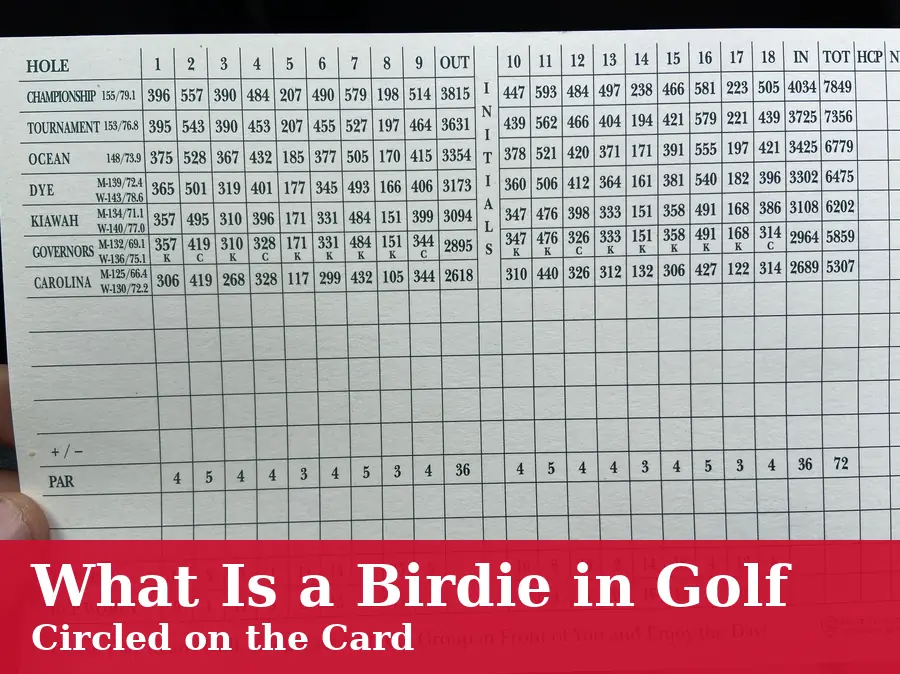
Scoring words exist in other sports too. Our guide to a football hat-trick shows how three goals work in one match. Golf cards use circles, while football fans just count goals.
How Often Do Golfers Make Birdies
Tour players make birdies far more often than club players. The Auckland guide puts the tour average at fewer than four birdies per round in 2024. That figure covers top fields, not weekend games.
Even Tiger Woods needs good approach shots to set up birdies. Club golfers make far fewer birdies, roughly one or two per round at best. New golfers may go many rounds with none at all.
Course length, wind and pin spots all shift the odds. Short par 3 holes offer the best odds for most players. Long par 5 holes test patience more than power.
How to Give Yourself More Birdie Chances
Every plan for how to make a birdie in golf starts with position. A ball in the fairway beats a ball in deep rough. A short approach putt beats a long one.
Pick a safe target off the tee, not the riskiest line. Leave the ball below the hole where you can. A putt uphill tends to stop near the hole.

- Hit the fairway first, then think about the flag.
- Aim for the wide side of the green on long shots.
- Practise short putts from 3 to 6 feet at home.
- Read the slope once, then trust your read.
- Take a calm breath before each putt.
- Play short holes with care, since they reward good tee shots.
Short game work pays off faster than new clubs. Ten minutes of putting work beats a long drive session. Small gains add up across a full round.
Mistakes That Turn Birdie Chances Into Bogeys
Most lost birdies come from one poor choice, not bad luck. A wild tee shot can force a rescue shot. A rushed putt can run well past the hole.
Chasing a tight flag often ends in sand or rough. A safe shot to the middle still leaves a putt. Patience saves more strokes than daring does.
- Do not aim at flags tucked behind bunkers.
- Do not hit a full shot from deep rough.
- Do not rush a short putt after a good approach.
- Do not change your routine when a birdie is near.
- Do not count the birdie before you hole the putt.
Good habits protect a card after one poor hole. Reset fast, pick a safe target, and move on. One bogey need not spoil a good round.
Your First Birdie Is Closer Than You Think
These first birdie tips for beginners work best on short holes. Pick a par 3, play safe shots, and trust one calm putt. For a wider read, our A-list celebrity guide explains fame words in the same plain style.
Now you know what is a birdie in golf, and why it matters. Book a short course round with a friend this week. Your first circled score may arrive sooner than you think.
Frequently Asked Questions
What is a birdie in golf?
You asked what is a birdie in golf, and the answer stays simple. It means one stroke under par on a single hole. Par sets the target, and one fewer stroke earns the birdie.
How many strokes is a birdie on a par 4?
A birdie on a par 4 takes 3 strokes in total. A drive, an approach shot and one putt form one simple route. Shorter routes work too, if the tee shot lands close.
What is the difference between a birdie and an eagle?
An eagle is two strokes under par on one hole. A birdie is one stroke under par on one hole. Eagles need a rare mix of length, luck and nerve.
Can a new golfer make a birdie?
Yes, a new golfer can make a birdie on a short hole. A good tee shot and one calm putt can do it. Short par 3 holes give the best early chance.
Does a birdie count in match play?
Yes, a birdie wins the hole in match play in most cases. Your rival must match it, or they lose that hole. One birdie can shift a tight match fast.