
Seventy minutes gone, your legs feel heavy, and the ball you would have reached in the first half rolls past you. That is the moment this guide is for. It explains how to improve stamina for football in plain steps that fit around team training, school or work, with a four-week plan you can start on Monday.
Most players train stamina the wrong way. They run long and slow every day, then wonder why they still fade late in games. Football is not a long run. It is short sprints, sharp turns and a jog back into shape.
The Short Version
- Build a steady aerobic base first with two easy runs a week.
- Add short intervals that copy match sprints, with full rest between them.
- Play small-sided games so fitness grows with the ball at your feet.
- Lift twice a week so your legs stay strong in the second half.
- Eat well, drink water, and sleep 7 to 9 hours a night.
- Follow the four-week plan below and change only one thing at a time.
What Football Stamina Really Means
Football stamina is the power to sprint, recover, and sprint again for a full match, then still think clearly in the last ten minutes. It rests on four parts: a strong aerobic base, repeat sprint power, legs that stay strong when tired, and recovery that lets you train again. Build all four and you stop fading late in games.
A match asks for bursts, not one steady pace. SoccerWares notes that Premier League players cover 10 to 13 kilometres in a match, with around 1,400 changes in activity. Most of that distance is walking or jogging. The game turns on the short, sharp efforts in between, so stamina here means repeat speed, not long distance.
Our guide to how many players are on a football team sets out the eleven on the pitch and what each line does, so you can match your running to your role.
Build Your Aerobic Base First
The base comes first. It is the slow, steady fitness that lets you recover between sprints and still run in the final minutes.
Two easy sessions a week are enough to start. Run 30 to 45 minutes at a pace where you can still talk in full sentences, on days away from matches. That pace is Zone 2, about 60 to 70 percent of your maximum heart rate. SoccerWares gives the old estimate for maximum heart rate as 220 minus your age.
How to improve stamina for football with Zone 2 running
Keep the run easy on purpose. If you cannot talk, slow down. Easy running is the unglamorous first step in how to improve stamina for football. One 30-minute easy run and one tempo session a week is a sound start: warm up for ten minutes, run 15 to 20 minutes at short-phrase pace, then cool down. The Football Association publishes fitness guidance, and its player fitness pages are a sound place to check the basics.
Intervals That Copy a Real Match
Once the base is there, intervals do the sharp work. They teach your body to sprint, recover in seconds, and go again. That pattern is the fastest route when you ask how to improve stamina for football.
Start with generous rest. Sprint 30 metres, walk back, and repeat six times. That is one set. Rest two minutes, then do two more sets. As the weeks pass, trim the rest or add a set, never both. A shuttle run works just as well: cones at 5, 10 and 20 yards, sprint to each and back, then walk.
Repeat sprint ability separates fit players from tired ones late in a game. Try 40-metre sprints with a slow jog back, ten times. If your times hold steady across the set, your stamina is growing. Stop the set if your form falls apart, because sloppy sprinting when tired is how hamstrings get hurt.
Small-Sided Games: Fitness With the Ball
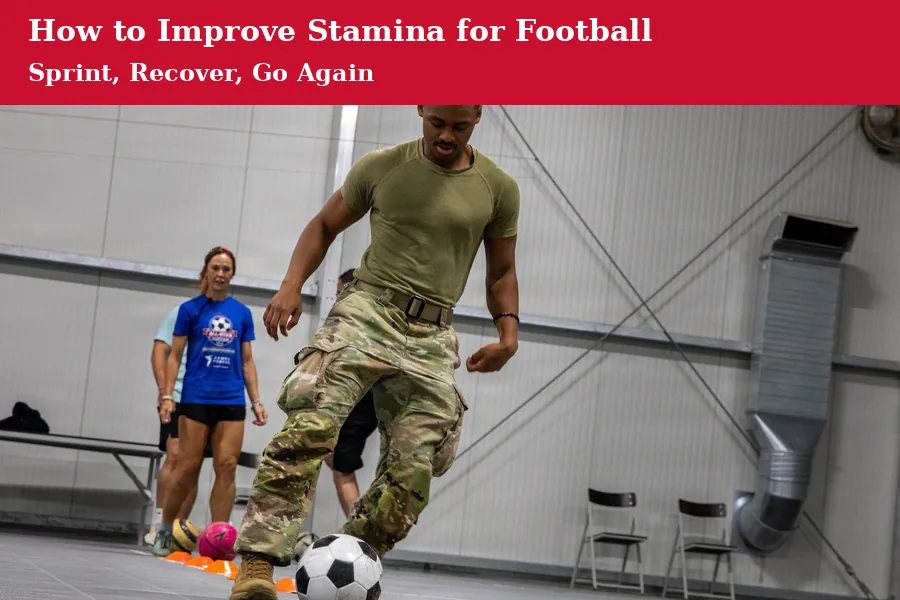
Running without a ball builds lungs. Running with a ball builds a footballer. Small-sided games give you both at once.
A 4v4 or 5v5 game in a tight area, played in four-minute rounds with short breaks, is honest conditioning. You sprint, turn, press, pass and recover without watching the clock. Limit touches to two to lift the tempo, or shrink the area so nobody can hide.
This is also where stamina meets skill. A tired player passes badly and picks the wrong run. Games under light fatigue teach you to keep your first touch clean and your head up when tired. That is the part of learning how to improve stamina for football that a treadmill can never give you, because decisions matter as much as running.
Strength Work That Keeps Your Legs Fresh
Strong legs fade more slowly. Two short gym sessions a week, on days away from matches, will carry you through the second half better than a third long run ever could.
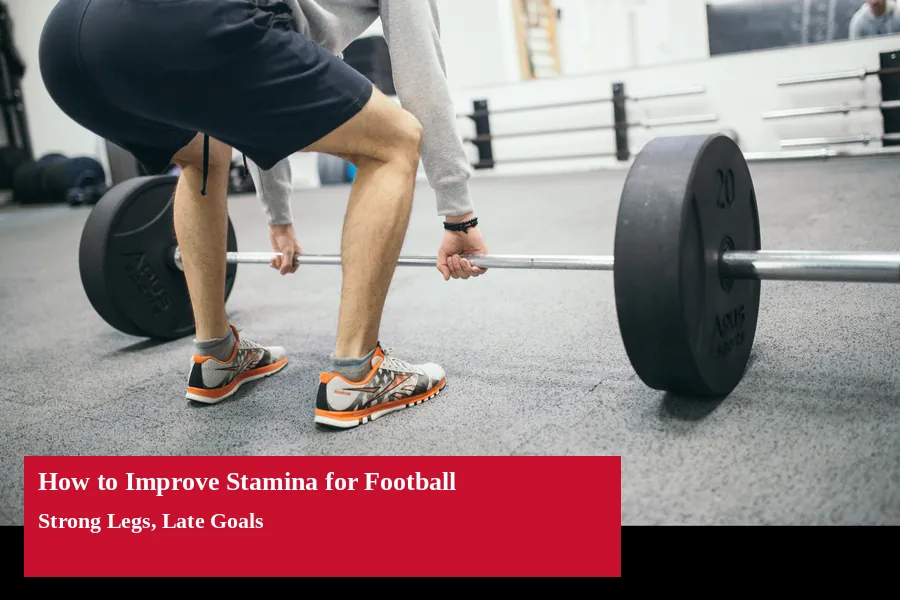
Keep it simple. Squats, deadlifts, lunges and split squats build the legs, with planks and side planks for the core. Aim for three sets of 8 to 12 reps, with 45 to 60 seconds of rest between sets. It should feel hard by the last two reps.
Learn the lifts before you chase weight. Ask a coach or gym instructor to check your squat and deadlift form in the first week. Warm up with five minutes of easy movement first. If a lift hurts a joint, stop and get advice. Sharp pain is not normal.
Food, Water and Sleep: The Quiet Half of Stamina
Training gets the attention, but food, water and sleep decide how much of it sticks.
Eat carbs around training and matches, because they refill the fuel your muscles burn at high intensity. Rice, pasta, potatoes, oats and bread do the job. Add protein at each meal: chicken, fish, eggs, beans or yoghurt. Eat two to three hours before training, then carbs with protein within an hour after.
Drink water through the day and take a bottle to training. Sleep is the part players skip first and regret most. FootballToast puts the nightly target at 7 to 9 hours. One full rest day each week is part of the plan, not a gap in it.

A Four-Week Plan You Can Actually Follow
This plan shows how to improve stamina for football in four weeks. It assumes two team sessions a week plus a match. Change one thing each week, and drop a session if you feel ill or pick up a knock.
| Week | Extra running | Intervals | Strength |
|---|---|---|---|
| 1 | Two easy 30-minute runs | None, base only | One light session |
| 2 | Two easy 30-minute runs | One session, 6 x 30 metres | Two sessions, 3 x 10 |
| 3 | One easy run, one 20-minute tempo | One session, 8 x 30 metres | Two sessions, 3 x 10 |
| 4 | One easy run, one 20-minute tempo | Two sessions, 10 x 40 metres | Two sessions, 3 x 8 |
FootballToast suggests most players feel a clear lift in 4 to 6 weeks, with faster recovery between sprints showing first. If your second-half running feels easier, it is working.
Warm up before every session. If you are young, back from a break, or have a health condition, check the plan with a coach or a GP first.
Mistakes That Waste Your Training Time
- Running long and slow every day, with nothing left for sprints.
- Adding intervals, extra runs and gym work in the same week.
- Skipping rest days and calling tiredness a lack of effort.
- Training through sharp pain instead of stopping and getting advice.
- Eating too little on heavy training days.
- Copying a famous player’s workout without checking your own level.
- Measuring only distance and ignoring how fast you recover between sprints.
The fix is simple: base first, intervals second, strength twice a week, food and sleep every day.
Your Next Match Starts on Monday
You do not need a new pair of boots or a secret drill. You need a base, short sharp intervals, games with the ball, two strength sessions a week, and rest. Start with week one of the plan above. That is how to improve stamina for football without gimmicks.
Four weeks from now, the last ten minutes can be yours. The player who still sprints in the 85th minute is rarely the most gifted on the pitch. More often, that player simply trained for the game as it is played, and that is how players reach the A-list of fame. To see how the game’s great moments reward that running, read our guide to what a hat-trick in football is, then pick your first session. More football guides sit in our Sports archive.
Questions Players Ask About Football Stamina
How long does it take to improve stamina for football?
Most players feel better recovery between sprints in one to two weeks, and a clear lift in second-half running in 4 to 6 weeks. That timeline comes from FootballToast and assumes two or three conditioning sessions a week. Judge it after a month, not after one session.
Is running every day the best way to build football stamina?
No. Daily long runs build slow distance, not match fitness, and leave your legs flat for sprints. Two easy runs, one or two interval sessions, and two strength sessions a week beat daily mileage. That steady variety is the best way to learn how to improve stamina for football.
What is the difference between stamina and endurance in football?
Stamina is the power to hold high-intensity effort and repeat sprints across a match. Endurance is the power to hold low to moderate effort for a long time, like a marathon runner. Football needs both, but stamina decides late-game moments, so intervals matter more than long runs.
Do I need a gym to build stamina for football?
No gym is needed to start. Bodyweight squats, lunges, press-ups and planks build useful strength, and that is enough to start learning how to improve stamina for football. A gym helps later, when you want heavier squats and deadlifts. Form matters more than weight, so learn each move first.
How should I eat on match day to last the full 90 minutes?
Eat a carb-rich meal two to three hours before kick-off, with some protein and little fat, then sip water through the day. After the match, eat carbs with protein within an hour. Skip heavy food close to kick-off, and test any new match-day meal in training first.